
• DE
  • Lösungen
    • Fire protection curtains

      Fire protection curtains

      Fire protection curtains are seal openings in walls and ceilings in case of fire. The constructional set-up (rolling- or folding technology) and the use of different fabrics offer a wide application spectrum as well as different protection targets or classifications and time classes. Casings and side guides of those flexible applicable systems are integrated almost invisibly in the building and provide much scope for design of sophisticated architecture for opened designs.

    • Conveyor system closures

      Conveyor system closures

      Manifold production - and logisitc processes require different construction types of conveying systems. If the haulage drifts are passing through fire-retarding resp. fire-resisting walls or ceilings, the necessary openings must be provided with fire protection closures to avoid the expansion of the fire by conveyor technique or by conveyed material. In case of fire the conveyor system closures have to seal those openings immediately and automatically. Thereby a classified fire resistance as well as the smoothly clearing of the closing area must be respected in case of release.

    • Smoke curtains

      Smoke curtains

      A smoke curtain is part of unit keeping areas free from smoke and may include building parts like natural smoke and heat venting systems and automatic smoke and heat venting systems. Smoke curtains restrict the movement of fire gases inside a building in case of fire.

    • Smoke protection closures

      Smoke protection closures

      In closed condition smoke protection closures restrict the passage of smoke in the phase of fire formation so as to enable the rescue of people, animals or materials assets in case of a fire in the room positioned behind it without the need of breathing protection.

    • Tube sealings

      Tube sealings

      The solution to problems with fire protection dampers for ventilation and air conditioning systems in conveying processes. Stöbich offers fire protection for pneumatic conveying lines where the closing elements are not exposed to the flow. Thus, damage or contamination of the closure element is avoided by abrasive conveyed goods.

    • Controls

      Controls

      Control systems are necessary for all automatic fire protection systems! They are safety-relevant, because without their function or in the event of a malfunction, the entire investment of a fire protection partition would be useless. Controllers coordinate both fire detection and the interaction with other controls, like superordinate building control or the retraction of the closing area at conveyor closing area.

    • Médiathèque Charles Nègre | Grasse, France

      Médiathèque Charles Nègre | Grasse, France

      The Médiathèque Charles Nègre in Grasse, France, is an impressive example of contemporary architecture that reflects the cultural and historical importance of the region. The information center with space for education, culture and encounters was opened in 2011 and designed by the renowned French architecture firm Marc Barani. The building combines modern aesthetics with the traditional architecture of Provence, creating a harmonious link between old and new, for example by combining modern materials such as glass and steel with local natural stone. The generous window fronts create an atmosphere flooded with light. Ecological sustainability is achieved through natural ventilation and the resulting reduction in energy consumption; green spaces are also integrated on various levels. Our <a href="/us/solutions/fire-protection-curtains/stoebich-fire-smoke-curtain-hc"><b>➥ horizontal Fire and smoke curtain hc</b></a> fire protection curtains fit perfectly into this marvel of contemporary architecture. They securely close the ceiling openings in the event of a fire, but otherwise remain invisible and let in plenty of light and air. Copyright attribution: © Ivry Serres

  • Referenzen
  • Themenwelten
  • Weltmarktführer
  • Nachhaltigkeit
  • News
  • Jobs
  • Kontakt

Wärmedämmender Feuerschutzabschluss textiler Bauart

Baureihe: Fibershield®-I

Der CE-gekennzeichnete Feuerschutzabschluss textiler Bauart erreicht nach EN 13501-2 die Feuerwiderstandsklassen EI<sub>1</sub> 30 - EI<sub>1</sub> 90 sowie EI<sub>2</sub> 30 – EI<sub>2</sub> 120 und darf in Größen bis über 7 m Breite und rund 5 m Höhe gemäß der harmonisierten Produktnorm für Feuer- und Rauchschutzabschlüsse EN 16034:2014 in Verbindung mit der EN 13241:2003+A2:2016 europaweit in Verkehr gebracht werden. Das System Fibershield®, Baureihe Fibershield®-I, ist die derzeit jüngste Generation von wärmedämmenden Feuerschutzvorhängen aus dem Hause Stöbich.

Isolierender Feuerschutzvorhang

Alternative zu Brandschutztoren und -türen

Gebäude werden in Brand- bzw. Rauchabschnitte segmentiert, um im Brandfall die unkontrollierte Ausbreitung von Feuer und Rauch zu verhindern. Damit der Brand nicht auf angrenzende Abschnitte übergreift, verschließt der wärmedämmende Fibershield® selbst große Wandöffnungen zuverlässig. Wärmedämmend bedeutet, dass nicht nur die Brandübertragung infolge von Flammendurchtritt (Klassifikation „E“), sondern auch infolge der Wärmeübertragung (Klassifikation „I“) verhindert wird. Der Fibershield® bietet Planern, Architekten und Betreibern eine optisch dezente und zugleich wirtschaftliche Brandschutzlösung. Er steht für wenig Platzbedarf, einfache Einbaubedingungen und großen Anwendernutzen.

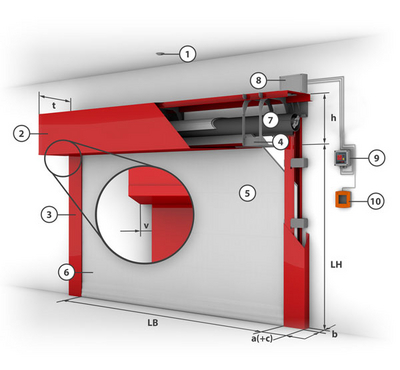
Der Fibershield® besitzt die Wickelkinematik eines Rolltores und benötigt nur einen geringen Bauraum oberhalb einer Wandöffnung. Dadurch lässt sich der textile Abschluss auch praktisch unsichtbar in abgehängte Decken integrieren. Das dünne patentierte Mehrlagengewebe und der ins Wickelrohr integrierte Antrieb erlauben Gehäuseabmessungen, die im Vergleich zu einem Brandschutzrolltor, nur die Hälfte oder ein Drittel so viel Platz beanspruchen.

Aufgrund der patentierten Sturzverriegelung kann optional auf die Verkleidung der Wickelwelle verzichtet werden. Damit lässt sich das Einbaumaß noch weiter verringern. Die Multi-Layer-Ausführung des Brandschutzbehangs aus isolierenden und kühlenden Lagen im Wechsel ermöglicht einen geringen Materialeinsatz und damit eine Gewichtsreduzierung gegenüber konventionellen Bauarten. Aufgrund des geringen Gewichts und Bauraums eignet sich das System besonders für die Brandschutz-Um- und -Nachrüstung in Bestandsbauten.
Gestaltungsfreiheit für Architekten und Planer

Die Abschlüsse ermöglichen auch im Neubau ungewöhnliche gestalterische Möglichkeiten, um außerordentlich große Öffnungen im Brandfall sicher abzuschließen. Im Fokus der Weiterentwicklung des Fibershield® stand die sehr einfache Montage. Die Führungsschienen sind steckbar ausgeführt, weisen keine sichtbaren Schraubverbindungen auf und können farblich ins Gebäudekonzept integriert werden.

Vorteile für Objektbetreiber

Der umbaute Raum eines Gebäudes soll optimal genutzt werden. Mehr Stellfläche für Paletten, mehr Nutzraum für Regale oder sonstige Einbauten machen sich in Form von verfügbarer Nutzfläche in Euro und Cent bezahlt. Für ein konventionelles Brandschutzelement muss im Tagesbetrieb üblicherweise seitlich der Wandöffnung Platz vorgesehen werden. Bei klassischen Brandschutztüren müssen die offen gehaltenen Türflügel oft durch eine aufwändige Stahlkonstruktionen als Anfahrschutz geschützt werden. Die Montage des Brandschutzsystems Fibershield® erfolgt oberhalb einer Wandöffnung. Die jetzt nicht mehr benötigte Parkposition für die konventionellen Elemente kann gewinnbringend genutzt, Geld für die Schutzmaßnahmen und deren Erhalt kann eingespart werden.