• FR
  • Solutions
    • Fire Protection Bonnets

      Fire Protection Bonnets

      • Copy-Cap WV
      • Copy-Cap WH
    • Fire protection curtains

      Fire protection curtains

      In case of fire, fire protection curtains close wall and ceiling openings. Their construction (roll-down or folding technique) and the use of different fabrics provide for a wide range of applications as well as different protection goals, classifications and time classes. The casing and guide rails of the highly flexible systems blend almost invisibly into the building and allow plenty of scope for sophisticated architecture and open room concepts.

      • Fibershield®-P
      • Fibershield®-E
      • Fibershield®-I
      • Fibershield®-HC
      • Fibershield®-S
      • Fibershield®-F
    • Conveyor system closures

      Conveyor system closures

      Various production and logistics processes call for the most diverse types of conveyor systems. If these conveyor lines pass through fire-retardant or fire-resistant walls or ceilings, the openings required for this purpose must be provided with fire protection closures to prevent the spread of fire through the conveyor system or the goods conveyed. In the event of fire, conveyor system closures (CSC for short) must close these openings immediately and automatically. Fire resistance classified according to DIN EN 13501-2 is just as important as the smooth clearance of the closing areas in the event of a fire.

      • ECClos®-S
      • ECClos®-Q
      • ECClos®-FLEX-I
      • Ecotube
      • GCC
      • BR100
    • Smoke curtains

      Smoke curtains

      A smoke apron is a part of a smoke control system which also includes other components such as natural smoke and heat exhaust ventilators (EN 12101-2) and mechanical smoke and heat exhaust ventilators (EN 12101-3). Smoke aprons restrict the movement of combustion gases within a building in case of fire.

      • Supercoil
      • Stripecoil
      • Smokeshield-S
      • Fixed smoke apron
    • Smoke protection curtains

      Smoke protection curtains

      Once closed, smoke protection curtains (SPC) restrict the passage of smoke during the phase of fire formation, so that in the event of a fire, there is enough time to rescue people and animals from the room behind the curtain and to recover material assets without the need for respiratory equipment.

      • Fiberseal
    • Gates

      Gates

      The solution for issues with fire protection dampers in ventilation and air conditioning systems in conveyor processes. Stöbich offers fire protection for pneumatic conveyor lines the closing elements of which are not exposed to the flow of conveyed material. This way, the closing element cannot be damaged or contaminated by abrasive conveyed goods.

      • Omnicompact
    • Control units

      Control units

      Each automatic fire protection system needs a control unit. They are critical to safety, because a failure of this function means that the entire investment into a fire protection sealing has been in vain. Control units coordinate both fire detection and interaction with other control units, such as higher-level building control systems or clearing of the closing area of conveyor system closures.

      • RZ7
      • RZ3/4
      • RZ8
      • Battery system
      • Movipower 350/550
      • UPS
      • FFE-KDR
    • Special Solutions
      • ECClos®-D
      • ECClos®-K
      • Universal-B
      • Universal-S
      • ECClos®-FLEX
      • Collar
      • Turbocoil
      • Omnitube
    • Technical Fire Protection
      • Fire Multi Detektor
    • Fire protection for battery storage
      • Strainbox XS
      • Strainbox S
      • Strainbox L
      • Strainbox XL
      • Strainlock
      • Packaging Cushions
    • Service
  • Références
  • Mondes thématiques
  • Leader du marché mondial
  • Durabilité
  • Actualités
  • Contact

ECClos®-Q

  • ECClos-Q

Description du produit

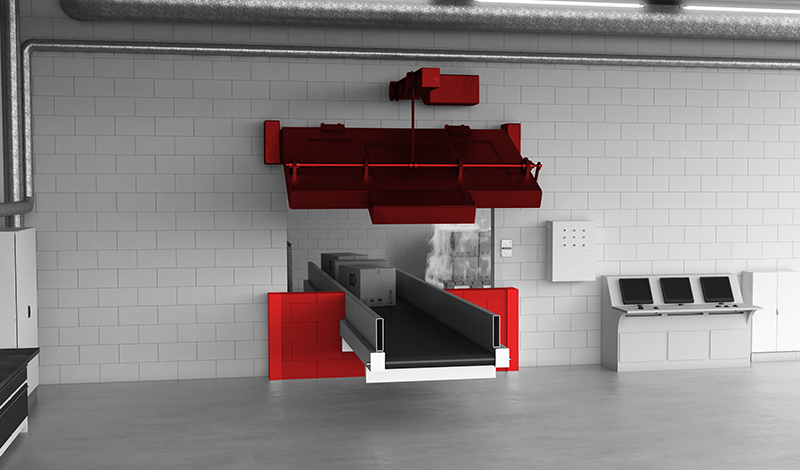
La construction du clapet à rotation horizontale requiert très peu de place dans la zone du linteau et est donc une alternative aux fermetures conventionnelles en construction à coulisseau. Ecclos®-Q répond aux exigences des classifications EI 30 à EI 120 et EW 240 (béton cellulaire). La feuille du clapet est en construction sandwich très stable et est complètement entourée d'une enveloppe en tôle. ECClos®-Q convient aux systèmes de convoyage continus et séparés comme les convoyeurs à bande pour bagages. Dans le cas de convoyeurs continus, le champ fixe est adapté de manière spécifique au client et la surface peut être réalisée selon les désirs du client en diverses exécutions.
Type de constructionFermeture coupe-feu dans le cadre des convoyeurs sur rails
Justificatif d'aptitude à l'utilisationEuropean Technical Assessment - ETA
Sens de fermetureà pivotement vertical
Résistance au feuE 240 | EI₁ 30 | EI₁ 60 | EI₁ 90 | EI₁ 120 | Contrôlé selon DIN EN 1366-7 | Classification selon DIN EN 13501-2
Cycles de fermetureC5 Nombre de cycles de fermeture 200.000
Réouverture Motorisé (standard)
Système de convoyageConvoyeur à courroie continu | Convoyeur à chaîne porteuse continu | Convoyeur à rouleaux continu | Convoyeur continu

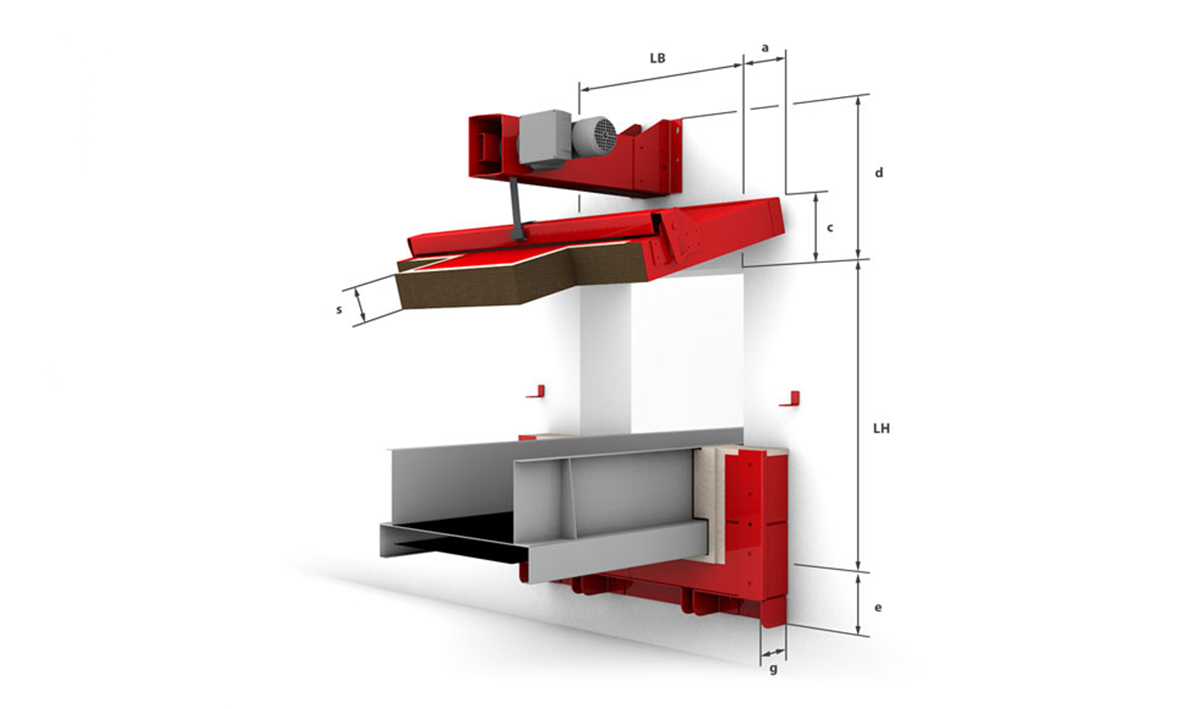
Structure du système (dessin du système)

ECClos-Q
a = 160 | c = 257 | d = 640 | e = 180 | g = 150 | s = 122
Qualité de mur nécessaire
Épaisseur de murd ≥ 200 mm
Maçonnerieselon DIN 1053-1
Bétonselon DIN 1045
Béton cellulaireselon DIN 4165
Mur à ossature en construction légèreselon DIN 4102

Domaine d'autorisation
LB850 mm - 1955 mm
LH900 mm - 1380 mm


Faisabilité technique
LBjusqu'à 4500 mm
LHjusqu'à 2500 mm